Jubilee Park Playground
Team members: Edison, Hannah, Cheryl, Pooja
Playspace Audit at: https://maps.app.goo.gl/mFVDevifM3MM3qwx6?g_st=ac
Nearest MRT Station: Fort Canning MRT Station (DT20), Exit B
With a focus on children and youth with cerebral palsy and autism
Overview of Jubilee Park Playground

Jubilee Park Playground is located within the Fort Canning Heritage Park, which directly faces Exit B of the Fort Canning MRT station (DT20). Unlike the common playgrounds in the neighbourhoods, the built structure of this playspace utilises the natural topography of the park, where different play areas are embedded directly onto the hillsides. This encourages children to not only navigate the terrain itself, but also to integrate nature and the park’s overall architecture into their play experience. Altogether, the playground is surrounded by a hilly and lush terrain, which creates a nature-oriented environment that can exude serenity.
This playspace looks to be designed to accommodate children of a wide variety of ages. Younger toddlers from ages 2 to 5 can engage in lower-intensity activities such as the gentler gradient slides and sandpits.
For older children from ages 6 to 12, the playspace also includes high-climbing structures and steeper-gradient slides, which can be more challenging and stimulating.
Some general features found in the playground that support access for some individuals with disabilities are swings with trunk support, water coolers and washing taps of shorter heights, and also wide paths with no sharp turns within the playspace.
In this blog post, we will be analysing how different elements of the playspace could support or limit children with cerebral palsy and autism.
Element 1: Wayfinding
Maps
The focus of the map at the entrance of the playground is on the entire park rather than the specific playspace, making it difficult to understand the sequence and flow of the playground.
Some children on the autism spectrum tend to value structure and predictability (Palmer et al., 2015) but if they were to refer to the map provided at the park, they might not be able to navigate with certainty and make informed decisions before entering the playspace. Hence, a specific pictorial layout of the Jubilee Park Playground could be provided for greater visual clarity.

The reduced scale of the map could help autistic children to understand the flow of playing without being overwhelmed by the irrelevant details of the larger park. By replacing the vague symbols with more realistic pictures of the play equipment, children on the autism spectrum can have a clearer visual cue to prepare for the shifts in their sensory environment. Children who struggle with understanding texts (Wahlberg & Magliano, 2004) and are able to communicate more effectively through images can also benefit from this redesigned map.
Element 2: Surfacing
Ground Surfacing
Sand is used as the surface finishing across multiple areas of the park, meaning children can choose where to play based on their individual sensory comfort. Children who feel overwhelmed by noise or crowds (Liang, 2024) can gravitate toward quieter sand areas, supporting solitary play as a means of managing overstimulation (Brown et al., 2021), while still remaining within the broader play space and able to engage in parallel play, which can be key to supporting playspace engagement for autistic children.
However, since autism is a diverse spectrum and children on the autism spectrum might have varying responses to different sensory-related stimuli (e.g. they may not like the texture of sand), other sensory elements like textured tactile panels (Miracle, n.d.) and musical elements (Eco Play Structures, n.d.) can be added to create a multi-sensory environment that offers alternatives for every child.
(Miracle, n.d.) (Eco Play Structures, n.d.)
These elements should be positioned at varied heights for accessibility and in a low-stimulus zone to reduce further sensory overstimulation.
Sand surfacing, while beneficial for some, presents challenges for others. For children with cerebral palsy, the uneven surface undermines balance and stability, while the curbs required to contain the sand create barriers for wheelchair users entering the play space. For some autistic children who are hypersensitive and dislike the texture of sand, the surfacing itself may deter entry altogether, limiting their engagement with the play space regardless of the equipment available.
Since sand surfacing presents both benefits and limitations, one recommendation would be to build a multi-surface playspace with partial rubber surfacing. Not only does the firm and shock-absorbent texture of rubberised surfaces provide a safe foundation for children who are prone to falls, but it also solves the entry issue caused by the curbs. Unlike sand, rubber surfaces can be leveled directly with the surrounding pavement, which removes the need for curbs and creates a smoother entry from the walking paths to the play equipment. An example of a playspace with adapted surfaces is shown in the picture below.

The sandy portion can also include a sand table that can be made accessible by providing a reach-adapted sand table and a pathway for access, as shown in the image below. This allows children to play together regardless of mobility levels and promotes independent play across the playspace as children can move with ease across the playspace.

Equipment surfacing (See-saw)

As the see-saw is made from metal and is exposed to direct sunlight, the equipment heats up easily, which may then lead to burns (Strong et al., 2007). This is dangerous for children with cerebral palsy as they might not react fast enough due to limited mobility, as well as children on the autism spectrum who are hyposensitive, increasing their susceptibility of burns.
Moreover, the surface of the metal see-saw is smooth and lacks friction, which is dangerous for children as they might risk sliding and falling off. This issue is worsened for those with cerebral palsy as they might be unable to properly break fall, potentially leading to serious injuries.
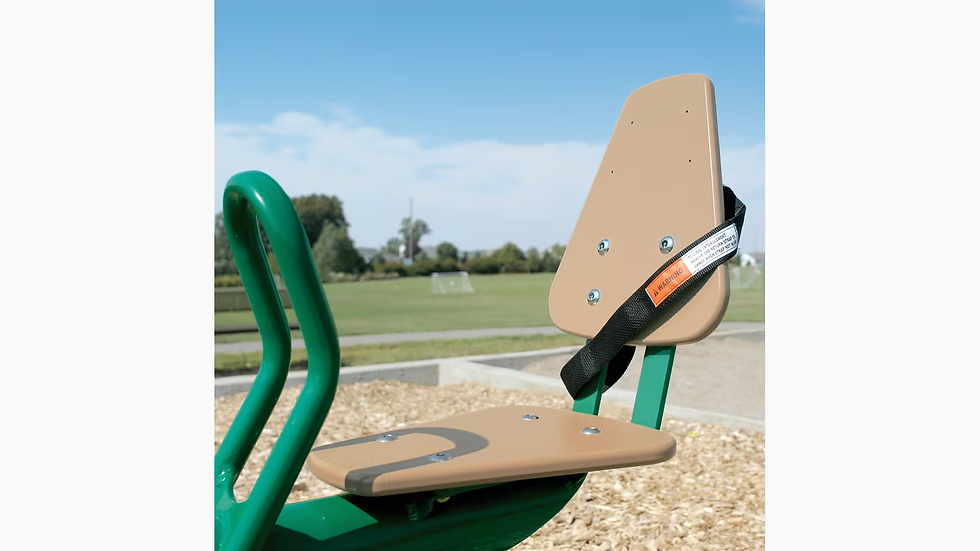
A recommendation to improve the see-saw is to add a layer of plastic coating to prevent heat gain, or use lighter-coloured equipment that reduces heat absorption. Gator grips can also be added to increase friction and prevent users from sliding off the see-saw. Adding proper seats with seat belts and backrests can provide an additional layer of safety by preventing children from falling, as shown in the image below.
Element 3: Access
Convenient access to the play area (Ramps)
Ramps are conveniently located on the way to the playspace and near the play spaces. These ramps have a light gradient, making it easier for children with cerebral palsy to access the equipment, as many might require walking aids or mobility devices. Moreover, children who might have a weaker vision are provided with a clearer and smoother path.
Furthermore, the paths and ramps have sufficient width for mobility devices to travel on. This ensures that those using mobility devices and their caretakers have sufficient leeway to walk on. (Brown et al., 2021).
Lack of access to certain play equipment (Slides and Treehouse)

Stairs leading to slide
(Bernard, 2026)
Picture of the treehouse before and after overgrowing of plants
Access to both the slides and treehouses is limited for children with cerebral palsy. Both of these pieces of equipment require children to climb a flight of stairs to access them. The treehouse also requires children to walk along a narrow rope to enter, and those with weaker arm strength and grip may not be able to access it. Furthermore, those with weaker vision might not notice the overgrown plants that extend into the narrow walking area of the rope, causing the children to suffer from cuts and injuries.
Considering these challenges, one recommendation would be to install switchback ramps with handrails at these elevated play equipment. Switchback ramps have a gentler gradient for those who are in wheelchairs or using walking aids to ascend slowly. Handrails also help to provide extra support for them. Replacing the narrow rope at the treehouse with a ramp that is wider and more accessible for wheelchairs can help to improve their overall participation in the playspace.

Reflections
The Jubilee Park playground, although needing some improvements, makes an effort to be inclusive, both intentionally and incidentally.
Ultimately, all children benefit from being able to spend time playing outdoors, in an unstructured environment, with the freedom to make their own play choices. After evaluating this playspace, we now understand the importance of providing access to these playspaces within our communities and making it truly accessible to all children. While no two children with disabilities are exactly alike, deliberately designing to cater to everyone’s needs is a complex but vital requirement for community inclusion.
A playspace requires a seamless integration of many aspects to constitute an accessible and inclusive area for play, going beyond simply checking off a checklist of playground equipment.
The absence of inclusive playspaces limits opportunities for non-disabled and disabled children to interact and engage with each other, and non-disabled peers may only get their knowledge about disability through textbooks. While education about disability is a necessary first step toward an inclusive community, it is not sufficient, meaningful inclusion requires actual interaction and connection (DSEA, 2009, p. 12), which inclusive play environments are well-positioned to facilitate.
References
Bernard, J. (2026). Guide To Jubilee Park Playground At Fort Canning Park: Sandpits, Climbing Nets, Swing Sets & More! Sassy Mama. https://www.sassymamasg.com/play-jubilee-park-playground-fort-canning/
Brown, D. M. Y., Ross, T., Leo, J., Buliung, R. N., Shirazipour, C. H., Latimer-Cheung, A. E., & Arbour-Nicitopoulos, K. P. (2021). A Scoping Review of Evidence-Informed Recommendations for Designing Inclusive Playgrounds. Frontiers in Rehabilitation Sciences, 2. https://doi.org/10.3389/fresc.2021.664595
DSEA. (2009). Creating an Inclusive Society: Practical Strategies to Promote Social Integration . chrome-extension://efaidnbmnnnibpcajpcglclefindmkaj/https://www.un.org/esa/socdev/egms/docs/2009/Ghana/inclusive-society.pdf
Eco Play Structures. (n.d.). Commercial Playground Design. EcoPlay Structures. Retrieved April 12, 2026, from https://www.ecoplaystructures.com/commercial-playground-design
Harris, K., Rosinski, P., Wood-Nartker, J., & Hill Renirie, R. (2022). Developing Inclusive Playgrounds That Welcome All Children—Including Those with Autism. Review Journal of Autism and Developmental Disorders, 11. https://doi.org/10.1007/s40489-022-00345-3
Landscape Structures Inc. (n.d.). Seesaw, 2-seats [Image]. https://www.playlsi.com/en/commercial-playground-equipment/playground-components/seesaw-2-seats/
Link, J. (2017, April 4). How to Make Sand Accessible at Playgrounds - Goric Marketing Group USA, Inc. Goric Marketing Group USA, Inc. https://goric.com/make-sand-accessible-playgrounds/
Liang, P. (2024). An Exploration of the Experience of Parents and Carers, When Supervising Autistic Children in a Playground (Version 1). Macquarie University. https://doi.org/10.25949/29896718.v1
Little Day Out. (2016, March 22). Inclusive Playgrounds in Singapore for All Children - Little Day Out. Little Day Out. https://www.littledayout.com/inclusive-playgrounds-in-singapore-for-all-children/
Miracle. (n.d.). Tots’ Choice Small Sensory Maze. Miracle Recreation. Retrieved April 12, 2026, from https://www.miracle-recreation.com/product/tots-choice-small-sensory-maze/?lang=can
Strong, D., Tahir, A., & Verma, S. (2007). Not fun in the sun: playground safety in a heatwave. Emergency Medicine Journal, 24(2), e9–e9. https://doi.org/10.1136/emj.2006.041657
Palmer, C. J., Paton, B., Kirkovski, M., Enticott, P. G., & Hohwy, J. (2015). Context sensitivity in action decreases along the autism spectrum: a predictive processing perspective. Proceedings of the Royal Society B: Biological Sciences, 282(1802), 20141557. https://doi.org/10.1098/rspb.2014.1557
Wahlberg, T., & Magliano, J. P. (2004). The Ability of High Function Individuals With Autism to Comprehend Written Discourse. Discourse Processes, 38(1), 119–144. https://doi.org/10.1207/s15326950dp3801_5


Comments