Canberra Park
Team members: Laiyinah, Sharon, Jeanette, Ryan, Ezekiel
Playspace accessibility audit at https://maps.app.goo.gl/ZoPrG1NRnHrKAyMt7
With a focus on children and youth with cerebral palsy and autism
Play Space Introduction
Our chosen play space is located within Canberra Park, alongside playgrounds of differing types, open grass patches and a basketball court. It consists of one main play area with two wheelchair-friendly equipment located in its vicinity. This play space has been designed to accommodate wheelchair users.
Four play elements located in the main area


Two other elements separate from main area


Element 1: Accessibility & Wayfinding
Canberra Park features large open spaces between play equipment, with seamless and flush surfaces connecting the pavement to the playground – a key strength supporting physical accessibility.

The spacious layout and flat terrain (Figure 1) enables children with physical disabilities such as Cerebral Palsy (CP), who use assistive mobility devices such as wheelchairs, to move around the play area independently with minimal caregiver support. They are able to navigate the area without obstructing others, protecting their dignity as they can move freely. This fosters confidence and promotes social interactions between other children at the playground. The large spaces also allow children on the autism spectrum space to engage in a range of repetitive movements (stimming), and pacing around without restriction, supporting regulation (Bates et al., 2026) when needed.
The lack of a map and explicit wayfinding information, however, may pose challenges for children with cerebral palsy and autism as they are unable to pre-plan their routes or identify accessible pathways that lead to essential facilities from the playground. This reduces predictability, which can be crucial for children with autism who rely on structure (Goris et al., 2019).
Element 2: Play Experience
See-saw
There is a see-saw that is accessible to wheelchair users (Figure 2), without requiring them to move out of their wheelchair. While it is designed to accommodate wheelchair users, it is still accessible to users of all abilities, reflecting universal design and inclusive participation. This promotes social competence through collaborative play.
However, the wheelchair logo on the see-saw may suggest that the equipment is only reserved for wheelchair users. For children with cerebral palsy who might already find it difficult to initiate social interactions (Borzenkova et al., 2018), integration becomes harder when such a symbol may deter non-wheelchair users from using the see-saw.
In addition, children with cerebral palsy may find it difficult to wheel the wheelchairs up and secure them on the see-saw due to the lack of safety bars and the placement of handles which may be out of reach, limiting their independence in play. While there are raised wheel stoppers, it may not be sufficiently effective in preventing backward movement. This increases overall safety risks and compromises overall play experience.
Multiple Slides
The multiple slides (Figure 3) support parallel play, a preferred mode of play for some autistic children (Jamera, 2019). It allows them to play independently, while being alongside others who are similarly engaged.

Play Stations
Play stations such as the finger-tracing escape maze (Figure 4) and puzzle (Figure 5) also enable flexibility in play. A variety of play stations provides choice for play engagement, supporting autonomy as they can participate in ways that align with their preferences.


Another play station is the musical notes element (Figure 6) which produces a loud “ding” sound when played. As some autistic individuals might have auditory hypersensitivities (Elwin et al., 2013), having loud, unpredictable noises in a shared setting may cause distress. As this element is part of the main structure of the playground, children on the autism spectrum may withdraw and avoid the space entirely as they are unable to control their exposure, reducing opportunities for active participation.
Element 3: Surfacing
Ramps
In terms of surfacing, ramps are designed to the elevated platform of the main play area (Figure 7), allowing wheelchair users and individuals with mobility aids to access the elevated platform easily.
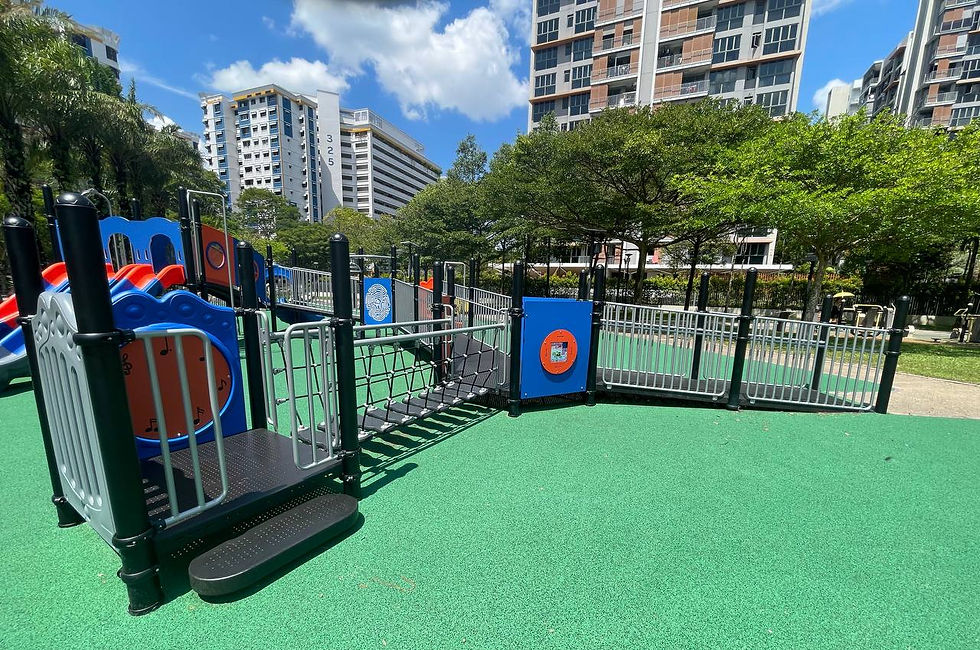
While these surfacing efforts enable wheelchair-bound users’ accessibility to the main play area, the ramp leads to a “dead end” as the path towards the slide becomes too narrow to fit a wheelchair. There are also no play elements to engage with after getting on to the mainframe. This creates a gap between surface access and meaningful participation as it limits children with cerebral palsy opportunities to engage in further play on the elevated platforms of the structure, despite being intentionally designed for access.
See-saw & Merry-go-round
Other than the main structure of the playground, play equipment such as the see-saw (Figure 2) and the merry-go-round (Figure 8) are easily accessible to all users due to their ramped access and the seamless surfacing.
However, independent participation of children with cerebral palsy when using these equipment becomes limited due to reliance on external force to facilitate movement. Consequently, these equipment would require caregiver assistance, limiting autonomy in participation in play.
Suggestions
1) Include Map & Incorporating Quiet Zone
We propose including a physical map (Figure 9) at entry points and a digital map posted online to indicate locations of different play elements, exit routes and nearby essential facilities. This visual representation enables children with cerebral palsy and autism to familiarise themselves with the new environment before and during the visit, supporting predictability and independence.

Organising the space into clearly defined zones allows for the inclusion of quiet zones as a designated area for children to retreat from overwhelming sensory input due to noise and overcrowding. Quieter spaces can be created near, but distinct from the active playground, allowing children to still feel included in the same playspace without being segregated from their peers (Figure 10). This might be especially beneficial for children on the autism spectrum who may need time and space to regulate themselves in overstimulating environments (van Rijckevorsel, 2025).

2) Including More Interactive Panels: Accessible & Multi-sensory Panels
The next suggestion would be to include more interactive and multi-sensory panels on the elevated platform. By incorporating various tactile elements of various shapes and sizes (Figure 11), as well as movement mechanics that can be pushed and pulled (Figure 12), it encourages sensory exploration and motor skill development such as grip strength and coordination, supporting meaningful participation in play. Additionally, by providing various features, it allows for choice and flexibility in the type of play a child wants to engage such as solitary, parallel or cooperative play depending on their comfort level. Examples of such panels from other playspaces are shown below:

Figure 11: Tactile elements of various shapes and sizes (New tactile panels - Hills/City/Sea, n.d.)

Figure 12: Movement mechanics on playground (Cunningham Recreation, 2024)
Modification of See-saw
Lastly, we propose to make modifications on the see-saw (Figure 13). Firstly, in the area of safety, handlebars should be repositioned at an appropriate reach so users can remain firmly in place when the seesaw is moving. Moreover, safety barriers can be installed at the side of the seesaws to reduce the risk of falling. Secondly, clear instructions should be included to ensure that children follow the proper steps to use the equipment safely. Lastly, the wheelchair sign should be removed to prevent any misconceptions of user, facilitating interactions between children with or without mobility difficulties.

Reflections
1) What changed in our group’s understanding of accessibility or play?
We realised that accessibility is a commonly overlooked consideration which is crucial in ensuring that play can be enjoyed by all children, regardless of ability. Furthermore, we learnt that creating inclusive spaces requires more than just the addition of new elements but intentional effort in integrating them into the existing play area. Proper integration is achieved when children of all abilities are able to use these play equipment intuitively.
2) An insight that surprised our assumptions
We learnt that play does not only involve the physical play space but encompasses the entire experience of arriving, engaging, and staying at the space. As such, inclusive play demands that measures are taken in each stage. Our play space had inclusive features for the engaging stage, but was lacking in the arrival and staying stages.
3) An implication for education in Singapore’s context
The opportunity for children to engage in play forms a crucial aspect of inclusive education. Through play, children with disabilities regain dignity and confidence in their interactions with their peers. Hence, their ability to integrate with others is severely hindered when play areas do not cater to their needs.
Secondly, we realised that besides accessibility, autonomy and flexibility of choice are important considerations that should be accounted for when creating inclusive play areas. True inclusion is achieved when children with special needs are not limited by their environment and can enjoy the same freedom as their peers.
Overall, we have learnt that true inclusivity is achieved when it is inherent and does not need to be explicitly stated.
References:
Barbara Butler Artist-Builder Inc. (2023). Retreat Hut at El Carmelo All-Inclusive Playground. Barbara Butler Artist-Builder Inc. https://barbarabutler.com/blog/retreat-hut-at-el-carmelo-all-inclusive-playground
Bates, J. R., Morris, I. F., Dameh, A. B., Paulus, C. R., Legrid, K., Chen, C., Zelazo, P. D., & Hall-Lande, J. (2026). Safety, connection, and communication: Qualitative insights into the multidimensionality of autistic stimming. Autism in Adulthood. https://doi.org/10.1177/25739581261424784
Borzenkova, G., Niedderer, K., & Rozsahegyi, T. (2018). Designing Play Equipment for Children with Cerebral Palsy: the context and design guidelines. Proceedings of DRS. https://doi.org/10.21606/drs.2018.491
Conn, C. (2015). ‘Sensory highs’, ‘vivid rememberings’ and ‘interactive stimming’: Children’s play cultures and experiences of friendship in autistic autobiographies. Disability & Society, 30(8), 1192–1206. https://doi.org/10.1080/09687599.2015.1081094
Cunningham Recreation. (2024). Interactive rocket ship park playground [Photograph]. Cunningham Recreation. https://cunninghamrec.com/articles/top-innovations-playground-design-2024
Elwin, M., Ek, L., Kjellin, L., & Schröder, A. (2013). Too much or too little: Hyper- and hypo-reactivity in high-functioning autism spectrum conditions. Journal of Intellectual & Developmental Disability, 38(3), 232–241. https://doi.org/10.3109/13668250.2013.815694
Goris, J., Brass, M., Cambier, C., Delplanque, J., Wiersema, J. R., & Braem, S. (2019). The relation between preference for predictability and autistic traits. Autism Research, 13(7), 1144–1154. https://doi.org/10.1002/aur.2244
Inclusive Seesaw . Proludic UK. (n.d.). https://www.proludic.co.uk/product/j987/
Jamero, J. L. (2019). Social constructivism and play of children with autism for inclusive early childhood. International Journal of Early Childhood Special Education, 154–167. https://doi.org/10.20489/intjecse.670475
Little Day Out. (2016). Inclusive playgrounds in Singapore for all children. https://www.littledayout.com/inclusive-playgrounds-in-singapore-for-all-children/
New tactile panels - hills/city/sea. Southpaw. (n.d.). https://southpaw.co.uk/products/tactile-panels?srsltid=AfmBOorUcfg_X9A8nhtH-ydtlTO3mcievtiEX9fzVuVqV6hCioQlEJtN
Poitras, I., Martinie, O., Robert, M. T., Campeau-Lecours, A., & Mercier, C. (2021). Impact of sensory deficits on upper limb motor performance in individuals with Cerebral Palsy: A systematic review. Brain Sciences, 11(6), 744. https://doi.org/10.3390/brainsci11060744
Proludic. (2026, April 13). Inclusive Seesaw J987 - Playgrounds - Moving equipment - Springers. Proludic UK. https://www.proludic.co.uk/product/j987/
van Rijckevorsel, C. (2025). Breaking Barriers - Inclusive Playground Design : Based on insights from a user-centred process, what design concepts can support meaningful play for children with Autism in playgrounds? (Dissertation). Retrieved from https://urn.kb.se/resolve?urn=urn:nbn:se:hj:diva-68471


Comments